Wednesday, March 29, 2017

Clean Line's REALLY Bad Couple-a Months...

In what is shaping up to be an incredibly rough couple months for Clean Line Energy Partners, several major blows have been dealt to the speculative development company:

Arkansas Full Congressional Delegation Comes Out Swinging

1) Arkansas' Full Federal Delegation Re-Introduces the APPROVAL Act (03/06/17)

On Monday afternoon, Senators John Boozman and Tom Cotton, along with Representatives Steve Womack, Bruce Westerman, Rick Crawford, and French Hill, re-filed S.529, the Assuring Private Property Rights Over Vast Access to Land ("APPROVAL") Act. The Act would amend Section 1222 of the 2005 Energy Policy Act to allow a state's governor and public service commission chair the opportunity to reject a federal transmission project if they don't feel like the project is in their state's best interest.

2) Arkansas' Delegation Sends Opposition Letter to Secretary Perry (03/07/17)

Alison wrote about this earlier, so I will just leave the letter here for everyone to see. It's a beauty.


3) Senator Boozman Makes Comments on Talk Business Arkansas (3/12/17)

Senator Boozman made comments during an interview with Talk Business Arkansas' Roby Brock further explaining the delegation's position that the use of Section 1222 of the 2005 EPAct by Clean Line is inappropriate:


In his comments, Mr. Boozman also brought further doubt about need for Clean Line's "product" at Tennessee Valley Authority (We know, Mr. Skelly, this is "bigger than TVA," we know. Whatever.), which brings us to:

Things Don't Look Great for Clean Line at TVA

1) TVA Winter Board Meeting (02/16/17)

It all started at TVA's February 16 board meeting. As you may have read in our January 2017 update, Clean Line and a couple environmental groups have been lobbying the Tennessee Valley Authority to sign a contract for a sizable chunk of wind energy from the Oklahoma panhandle and use Clean Line's proposed Plains and Eastern transmission line to deliver it to them. We explained to you that, if TVA were to sign a contract, the prime time to have done so would have been by December 31, 2016. That date has come and gone, and there was no publicly available contract on January 1, and as of today there still is not.

In past TVA board meetings (specifically August 2016 and November 2016), Clean Line sent their revolving door DOE star, Jimmy Glotfelty, to lobby (*read - "beg") TVA to make a commitment to use their transmission line. At the most recent board meeting held February 16, however, there was a specific lack of anyone representing Clean Line. The only person that showed up (and, she always does) to lobby for them was Chris Lunghino of the Southern Alliance for Clean Energy.

Why do we say that things don't look good for Clean Line at TVA? We have a couple key pieces of evidence. The first involves a presentation Mr. Bill Johnson, President and CEO of TVA, gave during his update at the board meeting. Take a look at the following slide:


Do you see what I see? If not, look a little closer... specifically at the amount of wind and solar energy TVA receives in 2017, and is projected to receive in 2026. They remain unchanged at 3%. What does that mean? Well, it would appear that it means TVA has no plans to purchase capacity for a large chunk of wind energy between now and 2026. You can infer from that what you will. Again, we know, Mr. Skelly, this project is "bigger than TVA." But, where are the other customers? We reported earlier that Georgia Power (GP) is likely out for Clean Line, and that still stands. Georgia Power is only allowed to contract 300 mW of wind power through its REDI program, and the in-service dates for GP's don't mesh with Clean Line's fantasy in-service date.

2) Senator Alexander (R-TN) Reaffirms TVA Doubts on the Senate Floor (03/22/17)

It must be really difficult for Clean Line and its' investors to see the senior senator from Tennessee say this on the Senate floor:


Senator Alexander: If you are watching, we would like to give our thanks to you for making these comments!

Oklahoma State Legislature Moving to Eliminate Wind Tax Credits

1) Oklahoma House of Representatives Passes Legislation to Eliminate State-Level Production Tax Credit for Wind Energy (03/10/17)

As we reported in our January update, the Oklahoma legislature is apparently serious about attempting to fix their nearly $900 million budget deficit. The Oklahoma House made the first move to eliminate early the state "Zero Emissions Credit" for wind energy. Without going into many details, the credit amounts to millions of dollars per year that come out of the state's coffers (paid for by Oklahoma taxpayers) to support companies that are mostly out-of-state (or country, in some instances).

Oklahoma gets a decent-sized chunk of its electricity from wind energy produced in state. Much of the energy produced by newer generators is exported out of the state, therefore Oklahomans are subsidizing wind energy companies for producing energy that largely has little-to-no benefit to the citizens of their own state... aside from the royalties landowners receive for voluntarily hosting the turbines on their property.

Meanwhile, Clean Line would like to potentially use (for the first time) federal eminent domain to force a swath 720 miles long of Oklahoma and Arkansas landowners to give up their property rights to construct its' for-profit transmission venture that could also require Oklahoma taxpayers to subsidize an additional ~2,000 wind turbines with zero in-state benefit... again, except to the landowners who voluntarily host the turbines on their property.

Does that seem fair to you? To me, it doesn't.

2) Oklahoma Senate Panel Approves Rolling Back Wind Tax Credit (03/29/17)

According to a report released today:
OKLAHOMA CITY – Legislation that rolls back a state tax credit for the wind energy industry has been approved by an Oklahoma Senate panel. 
The Senate Committee on Appropriations on Wednesday voted 34-6 for the House-passed measure and sent it to the full Senate for consideration. 
The bill modifies the tax credit for electricity generated by zero-emission facilities like wind turbines. It says facilities must be in operation by July 1 in order to qualify for the credit, instead of the current deadline of Jan. 1, 2021. 
Gov. Mary Fallin has proposed eliminating the credit to increase revenue amid a projected $868 million budget shortfall next year. The tax credit will cost $40 million this year and will average $60 million a year over the next 15 years.
The legislation appears to be poised to pass. We will see if the Oklahoma Senate is as serious about it as the House in the coming days. If the Senate passes the bill, it will be delivered to Governor Fallon for signature.

3) Mario Hurtado says: "No Big Deal" to Losing Oklahoma PTC (03/29/17)

In his typical blustery and arrogant (disconnected?) fashion, Clean Line's Mario Hurtado said the following in a recent article:
Hurtado said HB 2298 should have little impact on a $2 billion high-voltage transmission line that will carry wind energy across Oklahoma and Arkansas to Mid-South and Southeast markets. The Plains and Eastern Clean Line transmission line, a 700-mile project that has been in the works since 2010, will have the capacity to deliver 3,500 megawatts of wind-generated electricity from the Oklahoma and Texas panhandles. 
Terminating the tax credits this year, if the bill becomes law, could have an impact on where those wind farms are sited. Hurtado said the companies that will build the more than 2,000 wind turbines needed to feed current through Clean Line’s transmission line base siting decisions on a number of factors, and tax policy is one of those factors. 
“It may change the amount of wind energy that connects to us ... (from) Texas versus Oklahoma — the Oklahoma Panhandle is not that wide (and) the wind doesn’t pay attention to state lines,” Hurtado said. “Unfortunately, that would mean less investment in Oklahoma and the school districts there — that could be a change, and that is certainly something we have made people aware of.”
There you have it, Oklahoma. Whatever, Mario.

4) Mario Hurtado says: "Foundations for generators are being dug and poured in the Oklahoma panhandle right now" (3/25/17)

In another recent article that is full of bluster likely targeted at the Missouri Public Service Commission and Clean Line's investors, Hurtado said the following:
Foundations for generators are being dug and poured in the Oklahoma panhandle right now, Hurtado said. General Electric — which will build converter stations located near Guymon, in Arkansas and near Memphis, Tenn. — has done a lot of engineering work ahead of building the stations, he said.
Pictures or it didn't happen, Mario. Today (03/29/17), you said that if the Oklahoma legislature repeals the in-state PTC, wind developers will just build generators to energize your line in Texas instead of in Oklahoma.

But, just four days ago, you said "foundations for generators are being dug and poured in the Oklahoma panhandle right now." What gives, Mario?

My analysis? Foundations for wind generators are most definitely being "dug and poured" in the Oklahoma panhandle, but they're not being "dug and poured" to supply Clean Line's proposed transmission line. For Mario to imply otherwise is disingenuous, deceptive, and pretty desperate, if you ask me.

You have to have customers for all that stuff to happen, Mario. To date, Clean Line has yet to release a single, legally bound, contractual customer on either the generation or end-use side of its proposed speculative transmission line. Unless and until a sizeable portion of their capacity is subscribed, everything Hurtado and Skelly say is bluster.

Things Don't Look Super Great for Clean Line in Missouri

1) Hearings Held on Clean Line's (latest) Grain Belt Express Application

As you may know, Clean Line had its week-long round of evidentiary hearings at the Missouri Public Service Commission last week. If you're interested about how the hearings went, I will leave that explanation to my friend, Keryn Newman. She wrote an excellent blog post summarizing the events.

2) Neighbors United Scores Victory That Could Dash Clean Line's Hopes in Missouri

In a nutshell, Staff at the MOPSC recommended that: 1) Commissioners deny Clean Line's application, or 2) Commissioners condition Clean Line's CCN with the requirement that they receive assent from all impacted counties. I'll leave you with Keryn's blog post about this decision, which explains how it could affect Clean Line's proposed "Grain Belt Express" line.

Due to State Action, Clean Line's "Rock Island" Project is Effectively Dead

According to a recent article:
House File 603, which Rep. Bobby Kaufmann, R-Wilton, called a “long-awaited bill protecting private property rights,” was approved by the House 93-0. 
The bill addresses what he labeled the state’s “largest blight,” the Rock Island Clean Line, an electric transmission line that would affect 1,500 Iowa landowners, as well the development of a reservoir in Clarke County and property owners displaced by Department of Transportation projects. 
It should be hard to condemn private property, it should not be possible to condemn private property for personal profit, it should be illegal to condemn private property for anything other than public use,” Kaufmann said.
We're with you, Representative Kaufmann. Iowa landowners are lucky to have you.

In Closing

This is already far too long. So if you have made it this far, I really appreciate you reading it. I hope it has been informative and maybe, just maybe, it gives you a little bit of hope in what can feel like a helpless situation.

I just have to close by asking Clean Line's investors: When does enough become enough for you guys? When do you come to the realization that someone else has spent upwards of $200 million of your money and, after nearly a decade, those people haven't produced a single cent of revenue in return for you? And there's really no return in sight, is there? When do you say to yourselves: "We've harassed these people enough. It's time to throw in the towel"?

Maybe that's why you're holding on for so long. I get it. You've spent a lot of money. But, it doesn't make it right for the harassment to continue.

I think the time is (or should be) fast approaching. If you have any sense of decency about yourselves, you should realize how many thousands of people you have negatively affected for the last many years. Have you no conscience? Do you think things are just magically going to get better?

It is time for you to pull the plug.

Wednesday, March 8, 2017

Arkansas Delegation Rolls Out the APPROVAL Carpet for Secretary Perry

I'm late. I meant to have this posted yesterday, but... life. Anyway, we're gonna keep this simple because some things don't need a lot of chatter...

On Monday afternoon, the Arkansas delegation filed the APPROVAL Act. 

On Tuesday, they sent a letter to newly confirmed Department of Energy Secretary Rick Perry. And it really perfectly distills the core issue with the Department of Energy's proposed participation in Clean Line Energy Partner's Plains & Eastern HVDC line:

Our objection to Clean Line’s application should not be viewed as a fight against renewable energy; we each understand the importance of having a reliable electricity grid and are strong advocates of a diverse energy portfolio, including wind, solar, hydropower, renewable biomass, and nuclear energy. Likewise, we do not take issue with the building of national infrastructure; robust infrastructure investments, including the enhancement of the electrical grid, are often productive undertakings.
Instead, our objections relate to the vast overreach the Obama Administration employed, allowing this project to skip the necessary protections which exist to protect state sovereignty and private property rights.
Throughout the history of electric transmission, factors for the approval of these lines have been reviewed and decided at the state level. As the nonpartisan Congressional Research Service has noted:
“The location and permitting of facilities used to transmit electricity to residential and commercial customers have been the province of the states (with limited exceptions) for virtually the entire history of the electricity industry. State and local governments are well positioned to weigh the local factors that go into siting decisions, including environmental and scenery concerns, zoning issues, development plans, and safety concerns”[1]
The rejection of the transmission line by Arkansas’s (PSC) forced DOE and Clean Line to resort to using Section 1222. This is the first time DOE has used Section 1222 to authorize the development, construction, or operation of transmission facilities, and the only partnership the Department has (to date) with an entity to do so.

Sigh. It's so good, right? Love those guys when it comes to this stuff... my Clean Line BFAPs. As to whether 1222 actually does give the DOE room to use eminent domain... I guess we'll wait and see what a judge has to say.

For a deeper dive into all of this stuff, please check out Keryn Newman's most recent blog post. She hits it as only Keryn can.

I should stop right here, but I can't. I promise I'm only going to address one of the reported responses to this legislation, though... And it actually didn't come from Clean Line (because we've all heard everything they say before. I read it and in my head I hear the noises grown ups make when they talk on Charlie Brown).

It actually came from the IBEW... Guys. C'mon.

Let me preface my comment by saying I am a freak for unions. I'm a Utah Phillips listening, Union Thugs following, right-to-work disdaining, union lover. However, "the IBEW strongly disapproves of politics getting in the way of American job creation"... Please. I'm assuming politics are fine as long as they actually create jobs then? It's just a problem when they get in the way?

Seriously, unions have got to stop allowing themselves to be used as corporate pawns. The whole concept of lifting and protecting the middle class goes out the window when you allow yourselves to be manipulated into strong arming regular people. You want jobs, we want you to have jobs... But we want to be kept whole, too. Is that not fair? We want bread, yes... but we want, what? What?? Roses too. Cripes.


Monday, January 30, 2017

Fake Newsiness


"A pre-inaugural list of top infrastructure projects, attributed to the transition team of President Donald Trump, doesn't reflect the administration's official views, White House officials say. 
In emails to the Arkansas Democrat-Gazette late Tuesday, presidential spokesman Sarah Huckabee Sanders said the list isn't a White House or a transition team policy document."

In my last solo blog post, I promised I would only write again if something really egregious
happened.

Guess what?

In the grand scheme of things, the 50 project infrastructure document "leaked" last week is not a big deal. Don't get me wrong, it's dubious as all get out. But the more that comes out about it's origins (consulting group= lobbyists), the clearer and clearer it becomes that this is more of a Governor's Association/Industry boner list than a well thought out proposal. If you're interested in reading more about the history of the list and don't have a subscription to Politico Pro, try these:

http://www.dallasnews.com/business/economy/2017/01/24/report-trumps-infrastructure-priorities-include-two-big-texas-projects

http://politics.blog.ajc.com/2017/01/25/donald-trump-tweets-a-motive-for-voter-fraud-claim/

http://m.dailykos.com/story/2017/01/25/1624695/-First-hints-of-just-what-might-be-in-Trump-s-infrastructure-bill-released-maybe-Or-not

Yes, you would expect some of these projects to be under consideration regardless of who was looking, but no... consideration doesn't equate to an action item. And in a time where "fake news" has become the rallying cry for anything one disagrees with, the fact remains (true, not alternative) that some of the reporting on this issue was grotesquely optimistic... I'm lookin' at you Arkansas Times ;) (P.S. If you're gonna quote a girl, call a girl) That witty, snarky banter makes for a nice echo chamber noise, but it's more truthiness than truth, Ernie. Why? Oh, because the truth is boring... and hard to get at... and maybe, just maybe, a little gray.

So, just for fun, let's talk a smidgen about permitting. I'm going to run defense for the entire Arkansas delegation for a minute here. Hold my coffee, Mr. Koch. Just kidding...

Ok, so both of the aforementioned Times articles push the idea that the delegation's support of the Keystone XL is evidence of their hypocrisy in terms of their stance on Clean Line. I understand. I get it. I cried for days after the election and I went to the Women's March in Little Rock. This last weekend was both heartbreaking and inspiring. We all approach issues from our own worldview. I believe there are valid reasons to challenge the delegation's general support of pipelines. And, honestly, if you want to go after them for taking money from the Koch brothers? Have at it. Just make sure you're publishing Clean Line's lobbying expenditures, too (Like you did on the $400 lunch)... And the AWEA... And every other moneyed special interest group that actually moves politics in this country.

If you want to go after them because of eminent domain, I'll pull your collar just a little, even though that's my primary area of interest. Same thing with permitting. Why? Because different types of infrastructure projects have different permitting requirements. Some happen at the state level (like transmission lines) and some happen at the federal level (like natural gas and some aspects of oil lines). Before we let our snark monsters rage at these guys, it's helpful to understand what's going on.

Keystone XL, DAPL, and Diamond require some level of federal permitting to build. Transmission lines, with a very few exceptions, are the providence of the state. Clean Line lost their bid for a CCN at the state level. Why? Because our state laws are not set up to permit merchant transmission lines without instate assets and with no mandate from an Regional Transmission Organization (RTO). This is not necessarily a bad thing depending on which side of the bench you're sitting on. If you're on Clean Line's side, it's a hindrance to development. If you're on the side of landowners, states rights advocates, and existing utilities, it protects the state and its residents from fly by night operations with no real intention of making a positive local impact. Mr. Dumas has no problem with Clean Line running to the Department of Energy (DOE) to kiss their CCN rejection boo-boo. Whatever, that's his prerogative, but the state legislature had a problem with it. So did the impacted landowners... And the federal delegation... because it's a valid complaint. Keep in mind that the legislation Dumas referred to was passed after Clean Line applied to the DOE, not before. They didn't try to fix it instate. They should have.

Now, if the argument is that the "balkanization" (they love that word, and all that it implies) of processes makes permitting huge projects like Plains & Eastern hard, there is every reason to have that discussion as a country, but you better bet your bottom dollar that the states aren't going to just roll over and hand the power that ensures their people are treated fairly to the feds. Especially if that means the feds use that authority to permit private projects that can't demonstrate necessity. Something tells me the RTO's won't be dancing in the streets about it either.

If anyone out there ready to rage against the delegation for their support of Keystone XL and DAPL... or Diamond for that matter, wants to help effectively (instead of just screaming into the abyss) they need to refocus their attention on the laws that govern regulatory agencies and the permitting processes that allow these projects to go through the way they do. Yelling at the delegation, the Corps of Engineers, or the PSC is like trying to put spilled milk back in a cup with a toothpick. If you want to effect change, you've got to change the laws. Bottom line... Or be ready to spend a lot of money on legal. The Diamond Pipeline is a four-hundred mile, 20" crude oil pipeline that was permitted without a comprehensive EIS because it didn't trigger a NEPA process and there is NO STATE LEVEL REQUIREMENT for one. If you're going to be pissed about something, be pissed about that.

Back to Clean Line... To be clear, both Keystone and DAPL were lacking permits that they needed to finish. In other words, there was a clear path the new administration could take to give those projects a push. How is that different from Clean Line? Well, for all intents and purposes, the Plains & Eastern project has been "approved" by the Department of Energy. Whether that "approval", or the process they used to get there, holds up in court is one thing, but the fact that they haven't started construction yet has nothing to do with the feds holding up their project and everything to do with the fact that Clean Line just can't seem to get it done. The Department of Energy set up specific requirements Clean Line has to meet before they will give them the go ahead to start construction on the line... These requirements (Conditions Precedent) for financing, subscription, etc... were established to protect the people of Arkansas, the SWPA, and the taxpayers in general. So what steps exactly could a new administration take to push P&E? Well, I don't know, but they'd have to be pretty creative. (By the way, if the new administration tried to get creative like that with a pipeline, the same people getting all warm and toasty over the possibility it could happen for Clean Line would be losing their marbles). And with all Skelly's bellyaching about changing the rules mid-process regarding the APPROVAL Act, they should be ready for a pretty significant backlash should they try anything sketchy.

While all these things seem kind of academic, it's pretty clear from Mario Hurtado's interview with NewsOK that the truthiness of this list isn't going to stop Clean Line from spinning it in a way they can use to preen (beg?) for financing and to pressure landowners.

"When the Trump campaign was looking at infrastructure, we thought it was a good thing to mention. We're just happy to be part of the conversation."
Like, when did you just happen to mention it? Did you run into them in the grocery store? How much did that conversation cost?

I'm not going to get into the potential psychological damage that comes from all these "nice" conversations my friend Mario claims to be having with people. I'm sure some of them probably are. Some of them probably aren't... and as I mentioned to an acquaintance the other day, we have a word for people who repeatedly contact you in spite of a clear request to be left alone. Who call you all the time and show up at your work and home uninvited. Who pressure you repeatedly into something you don't want to do, threatening you with financial harm. Who contact your family members to try and get in touch with you. Who make you feel alone and at risk... They're called "stalkers" and there is no other situation in society in which this kind of behavior is acceptable. By the way, is a "fair deal" an easement "option"?

This is already too long and I have other things to do today, but... in closing. There are three things everyone needs to remember in this somewhat surreal situation:

1. There is still an outstanding federal lawsuit against the Department of Energy regarding this project.

2. The Department of Energy has yet to announce that Clean Line has met the Conditions Precedent they need to move forward.

3. Lobbyists are constantly working on behalf of their clients. At the federal level and at the state level. So this kind of stuff... this "newsiness" is only the beginning. As the new administration settles in and establishes its goals, the swamp ain't going anywhere without a fight. And you can bet that whatever infrastructure plan, commission, or law finally takes place, it's going to have their greasy little fingerprints all over it. The ONLY way for people to get adequate representation in that process is for them to engage and fight for it. My generation was asleep and at war when the 2005 Energy Policy Act was passed. We've woken up. Stay awake.

Sunday, January 22, 2017

January 2017: Clean Line Post-Election Update...

Happy (belated) New Year from Ali and Dave!

We sincerely hope you had a wonderful, Clean Line-free holiday season. Unfortunately, with the holidays coming to a close, we all have to remain informed and vigilant. Remember, while many of you only found out about this project in late 2014, Michael Skelly and crew have been actively attempting to execute this boondoggle since 2009... maybe earlier. It's hard to say with certainty exactly when the idea for this first arose. As we have written about before, Jimmy Glotfelty (cofounder of Clean Line) lobbied Congress in 2003 during his stint at the Department of Energy (DOE) in support of the very same provisions (Section 1221 & 1222) that his company is attempting to utilize now. We thought we would take this opportunity to provide you with an update, as well as a few things you should be paying attention to as we move through 2017:

Donald Trump, Scott Pruitt, and Rick Perry

Donald Trump:


As a rule, we keep politics out of this issue. It is not a political issue. It is a private property and states' rights issue. However, as all of us are aware, we had an election last year. Hate it or love it: Donald Trump was sworn in as President of the United States of America on January 20. Elections have consequences. As a good friend of ours stated a couple days after the election: "I'll bet Clean Line woke up and sh*t their pants on November 9." We tend to agree. To say the results of the election were anything less than unexpected would be an understatement. Jimmy Glotfelty has already attempted to set the stage for a change in conversation at the TVA board:
"Election Day was a big sea change in America," Jimmy Glotfelty, executive vice president for Clean Line Energy Partners, told the TVA board last week. "But we believe that just because we've gone from Democrats to Republicans (in the White House) that does not change the need for jobs and low-cost energy in America and we believe we will provide that. We've been before this board for the past seven years and our project dynamics have not changed."
But the truth is that no one can say right now what the Trump presidency means for Clean Line, which is due in part to the very nature of the project. Yes, it represents private investment in infrastructure, but it also represents an example of gross federal overreach in which the Department of Energy virtually ignored not only state law, but an established state PSC ruling.

With past comments like these, it will be interesting to see what his position is:


Scott Pruitt:


As some of you may remember, Scott Pruitt is the Oklahoma Attorney General. During the comment periods for both the NEPA review and the Section 1222 "review", his office issued scathing comments in landowners' and states' favor in opposition to the process being used to advance this project.

Why is that important? Because Scott Pruitt has been nominated to become the next EPA Administrator. He has been a staunch opponent of the "Clean Power Plan" (CPP). The CPP has been a primary justification by Clean Line for the "necessity" of their line. Under a Trump administration, the CPP will likely be nullified. Love it or hate it, it is what it is.

If you're interested in viewing Mr. Pruitt's confirmation hearing, you can do so here (Part 1):

and here (Part 2):

Rick Perry:


Why is former Texas Governor Rick Perry involved in this? Because he has been nominated to be the next Secretary of the Department of Energy. He is sort of a wild card. While he is mostly an oil and gas person, he also supported the so-called "Competitive Renewable Energy Zone" (CREZ) transmission expansion for wind energy in Texas. Many environmental-types seem to see this as a positive attribute in Perry for renewable energy. Others see this support as having been less about wind energy, and more about an economic opportunity for Texas. The CREZ lines were concocted and approved IN Texas, FOR Texas. Whether or not support for larger projects like Clean Line's translates to support from Mr. Perry at the federal level remains to be seen. He is known for being a staunch states-rights advocate. In fact, Mr. Perry wrote in a 2009 blog post:
The Founding Fathers understood that a one-size-fits-all approach just doesn’t work, especially in a country the size of America, and it certainly doesn’t work for Texas. Our economic strength, compared to the federal budget mess and other states’ troubles, is evidence that Texans know what’s best for Texas. 
The Constitution simply does not empower the federal government to override state laws without restraint. 
I agree with Texas’ 7th governor, Sam Houston, who once said, “Texas has yet to learn submission to any oppression, come from what source it may.”
We didn’t like oppression then and we certainly don’t like it now. Unfortunately, pressure is increasing from a federal government that is growing increasingly oppressive in its size, its intrusion into the lives of our citizens, and its interference with the affairs of our state.
Also:
In his book, he sets out a view that the founders intended a federal system that allowed “people of like mind” in the states to make their own decisions about how to live, while the national government’s role was properly focused on national security. “From marriage to prayer, from zoning laws to tax policy, from our school systems to health care, and everything in between,” he wrote, “it is essential to our liberty that we be allowed to live as we see fit through the democratic process at the local and state level.”
While we don't have much indication as to which side Mr. Perry will ultimately fall on RE: Clean Line, we are paying attention. We stand ready to work with the new DOE Secretary (whether Perry or someone else) on this important issue. We are hopeful Mr. Perry, if confirmed, will bring the same respect and zeal for states' rights to the Department of Energy.

If you're interested in listening to Mr. Perry's confirmation hearing, it can be viewed here:


Tax Credits for the Wind Industry

Federal Production Tax Credit Down 20% in 2017:


As you may know, Congress passed an extension to the Production Tax Credit (PTC) for the wind industry in late 2015. However, a year-over-year PTC reduction will occur until the end of 2019:
The tax credit is phased down for wind facilities and expires for other technologies commencing construction after December 31, 2016. The phase-down for wind facilities is described as a percentage reduction in the tax credit amount described above: 
  • For wind facilities commencing construction in 2017, the PTC amount is reduced by 20% 
  • For wind facilities commencing construction in 2018, the PTC amount is reduced by 40% 
  • For wind facilities commencing construction in 2019, the PTC amount is reduced by 60%

Oklahoma's Budget Deficit and In-State Wind Tax Credits:


As many of our readers may know (Oklahoma's, especially), Oklahoma has, by state standards, a massive budget deficit. From a recent article:
(Reuters) - Oklahoma's budget deficit will be $868 million next year, higher than recent estimates as sustained low oil prices, tax cuts and corporate tax credits continue to weigh on the state's finances, the Oklahoman newspaper reported on Tuesday. 
Governor Mary Fallin estimated just days ago that the state would face a $600 million gap for the 2018 fiscal budget year, but Finance Secretary Preston Doerflinger told reporters at a news conference on Tuesday that the hole will be deeper.
A $900 million budget shortfall would represent nearly 15 percent of its expected $6 billion in spending power.
 
With less money to spend, state lawmakers could choose to make cuts to government services like education and health care or raise taxes. 
"I think it's important for everybody to realize you're not cutting your way out of this situation," Doerflinger said. "We have to have a serious conversation about revenue."
One of the "corporate tax credits" weighing on Oklahoma's budget is a state tax credit for wind energy. Tax credits paid by taxpayers to (mostly out-of-state) wind companies have ballooned in the past few years:
"Oklahoma is bankrupt and unable to pay its bills because of $1 billion worth of tax cuts, hundreds of millions of dollars in gross production tax giveaways to the oil and gas industry, and $2 billion worth of tax credits and exemptions to wealthy corporations, all of which this governor supported," said House Democratic leader Rep. Scott Inman, of Oklahoma City. "That's the reason we're in this mess. To get out of it, we need to roll back those irresponsible tax plans, not raise taxes on working families." 
Another likely target for revenue will be some of those hundreds of millions of dollars in incentives Inman spoke of — specifically a credit for the production of wind energy that an independent consulting group has recommended be capped or ended. Payments under that program have skyrocketed from $3.7 million in 2010 to more than $113 million in 2014.
Numbers were not available for 2015 and 2016, but many, many more wind turbines have been constructed in Oklahoma in those two years. That number would have to be much higher for 2016. What do you think the 2,000 additional wind turbines Clean Line would like to see constructed in the Oklahoma panhandle would do to that figure? Our opinion: since wind tax credits account for at least 15% of Oklahoma's budget deficit, lawmakers in that state are going to be required to get serious about capping or eliminating them in the 2017 session. Will they wind up with a result that is fair to Oklahoma taxpayers? Who knows. In this age of "pay-to-play" politics, we would say that nothing would be surprising.

Relation to Clean Line:


So, how does this relate to the Plains and Eastern (P&E) project? Quite simply, as the years progress, Clean Line's "delivered product" becomes more expensive and less financially appealing to end-use utilities. The price of delivered energy on P&E to an end-use utility (such as TVA, Georgia Power, etc) is composed of the price a wind generator can produce the energy for, added to the cost of delivery Clean Line will charge to deliver the electricity to the TVA system, plus whatever TVA would charge to wheel that electricity through their system to them. If the cost of the electricity rises on the generation end, the cost of the electricity on the receiving end rises, as well. So, how does this relate to the TVA?

Clean Line and the Tennessee Valley Authority

As discussed above, the "prime time" to sign up for capacity on Clean Line's proposed transmission line was by the end of last year. And, Clean Line and others have parsed no words in attempting to push TVA to sign a contract for electricity on Plains and Eastern. Take, for example, this fluffy article from Dave Flessner that seemed to imply that TVA was right on the brink of signing a contract with Clean Line before year's end:
The Tennessee Valley Authority is studying whether to contract this year to buy into what would be one of the biggest wind energy projects in the country. 
Despite last week's election of a new president who has pledged his support for more fossil fuel power generation, TVA President Bill Johnson said the utility is still studying whether to ink a deal in the next six weeks to buy at least some of the wind-generated power windmills a Houston group is trying to transfer across the middle of America. 
Clean Line Energy Partners LLC is planning to build high-voltage, long-distance transmission lines to carry power generated by windmills in Texas and Oklahoma to the Tennessee Valley. The development group wants to reach a deal with TVA to buy its power before the end of this year to take advantage of maximum federal tax incentives for wind generation that will not be as generous after this year.
Or, this earlier article by Mr. Flessner with an equal amount of fluff (there seems to be a pattern with him):
Jimmy Glotfelty, executive vice president for Clean Line Energy Partners, told the TVA board last week that it could deliver wind-generated power from Oklahoma and Texas up to 60 percent of the time at around 3 to 3.5 cents per kilowatt-hour, which is cheaper than some of TVA's other energy costs. Such wind-generated power could be available in two to three years after new wind turbines are erected in Oklahoma and Texas, where the wind blows more steadily than in the Southeast, and after Clean Line builds its proposed 700-mile line from the panhandle of Texas to Memphis. 
The cost will be cheaper this year because the maximum federal production tax credits, worth the equivalent of 2.2 cents per kilowatt-hour, will begin to decrease after Jan. 1."We continue to have strong discussion with utilities in the Southeast and we continue to have productive talks with TVA because we believe this is a very competitive source of clean energy which we think would add value to their portfolio," Glotfelty said.
(If you're interested in watching Mr. Glotfelty plead as an ordinary citizen for TVA to purchase their "product" before the end of 2016 at their August 2016 board meeting, click here and fast forward to minute 138:00 or 2:18:00, or at their November 2016 board meeting by clicking here and fast forwarding to minute 35:00 or 0:35:00.)

Environmental groups have also been lobbying TVA hard to sign a contract with Clean Line by the end of 2016. Back in August, Dr. Stephen Smith of the "Southern Alliance for Clean Energy" even went so far as attempting to offer the Plains and Eastern transmission project as a potential aid in the solution to the Zika virus (it's hard to make this stuff up, folks). In November, Allie Brown (also of SACE) had this to say:
Clean Line’s transmission project is a no-brainer for TVA and other Southern electric companies to buy into. It will help diversify our energy mix, create tens of thousands of jobs, protect natural resources, and provide health benefits by decreasing pollution from fossil-fuel generation in our region. 
Critical deadlines regarding the federal production tax credit for wind power are fast approaching. Fortunately, contracts for wind power can be signed today, but can take delivery as late as December 2020, and still qualify for the important tax incentive. We strongly encourage TVA’s board of directors to immediately contract for at least 1,000 megawatts of wind power on the Plains and Eastern Clean Line. We need your help to urge TVA to buy wind power from Clean Line today:
SACE even created this nifty petition.

This guy even threw his hat into the ring with an op-ed entitled: "Tennessee Valley Authority should get into wind power". Leaving out the obvious fact that TVA is already "into wind power," the opinion piece seemed to be neatly crafted with all of Clean Line's dead-horse talking points. Accident? Probably not. The op-ed was printed after December 31, however, so it's doubtful anyone at TVA actually read it.

Clean Line STILL Has No Publicly Available Contracts:


Despite all the fluff and bluster, Clean Line has still yet to release a single publicly available contract for transmission capacity on Plains and Eastern from TVA or anyone else. As with any business, customers draw more customers, so it seems highly unlikely that Clean Line wouldn't have released information about a major contract with TVA. As we have become accustomed, it seems incredibly hard for them to keep positive news on the proverbial "down low". It would also seem unlikely, with credits being reduced, that a rising "delivered product" price for Clean Line would provide increased incentive for an end-user contract in 2017.

But what do we know? We're just "misinformed" landowners.

Tuesday, August 16, 2016

Landowner Groups File Legal Complaint Against U.S. Department of Energy Over Clean Line Decision

FOR IMMEDIATE RELEASE:

Please refer media inquiries to:

Gill Ragon Owen, P.A.
Jordan P. Wimpy
(501) 801-3816 or jwimpy@gill-law.com


Landowner Groups File Legal Complaint Against U.S. Department of Energy Over Clean Line Decision

Golden Bridge, LLC, and Downwind, LLC, two organizations representing the property rights and interests of member landowners along the entire route of the proposed "Plains and Eastern" HVDC transmission line in Arkansas, filed a legal complaint against the Department of Energy and the Southwestern Power Administration regarding their approval of and participation in the proposed project. "Landowners were never offered an appropriate avenue for due process during the DOE's review of Clean Line's application," said Dave Ulery of Golden Bridge. "An opportunity to comment is not the same as an opportunity to directly participate in the matter in an official capacity. Review is meaningless if those most affected are not given ample and significant opportunity to engage on a meaningful and substantive level."

The legal complaint raises concerns regarding the legality of the Department of Energy’s decision to participate in the project using Section 1222 of the Energy Policy Act. “While understanding the importance of infrastructure in the production, transmission, and distribution of electrical energy,” a spokesperson for Downwind noted, “the landowner-managed organization is concerned with the federal government’s legal authority, and the scope and manner of its proposed participation in transmission projects pursuant to Section 1222. There are lingering doubts about the substance and merits of the Department’s determination in this project, with particular concern relating to the potential use of federal eminent domain to condemn private property for the benefit of a private, for-profit company.”

Both groups continue to accept new members. For more information, please go to www.GoldenBridgeAR.org.

Contact:

GoldenBridgeAR@gmail.com
Golden Bridge, LLC
4300 Rogers Ave., Suite 20-148,
Fort Smith, AR 72903

Thursday, July 21, 2016

Who wants some Clean Line whine?

Drink up! It's free, and Dave Berry has been handing it out without restraint in Georgia recently. Full disclosure: this post is long and nerdy. I am completely convinced that no normal person would want to read this stuff.

Introduction

Many of you are aware: Clean Line (and all of us, unfortunately) has a long road ahead of them with their "Plains and Eastern" project. Landowners oppose the project in record numbers, the entire Arkansas federal congressional delegation supports us (thank you!), and they have quite a few hurdles to jump before any shovels hit the ground. After the Department of Energy's recent approval, one of the biggest hurdles Clean Line has to jump over is obtaining customers. Not "letters of intent" or the like, but REAL, firm, and enforceable contracts for capacity on their line.

They need customers, customers, customers... like, yesterday. Customers are the butter for their bread. Without them, they can't use eminent domain against us, the DOE won't help them with landowner negotiations, they can't get financing, the line becomes financially unfeasible, and it doesn't get built. Period. As frustrating as it is... in this case, time is our friend.

These things being said, I would just like to say that being as immersed as we have been in this process and opposition for going on three years now, it is a spectacular emotional (and physical) roller coaster. There is constant worry, and you're always trying to find something, anything, to ease your mind a bit. If there's anything we've learned about Clean Line, there are two sides to them: There is the public, rosy aura that they want you to perceive, and then there are the things that are going on behind the scenes to accomplish their goals. Sometimes it takes a bit of digging to get the full picture. I hope you enjoy.


Clean Line Needs Customers

Really, Clean Line has just has about three options when it comes to subscription:
  1. Large utilities such as the TVA, Southern Company and it's subsidiaries, Entergy Arkansas/Louisiana, etc, can buy large chunks of their capacity. One would have to assume that this option would be preferable to CLEP because it is the easiest for them.
  2. Smaller municipal electricity co-ops throughout the "midsouth and southeast" can sign much smaller capacity contracts in the 25-50mW range. It takes a LOT of those to fill the capacity of a 4,000mW line.
  3. There are some corporations that want to "green" their image. Imagine the scenario where a few private, for-profit "Fortune 500" companies are alright with other another private, for-profit company seizing land from private landowners to aid in their quest to make themselves look good. Yeah, that's the point we've gotten to in this country. Here's evidence:

Enjoy your Corn Flakes, folks!

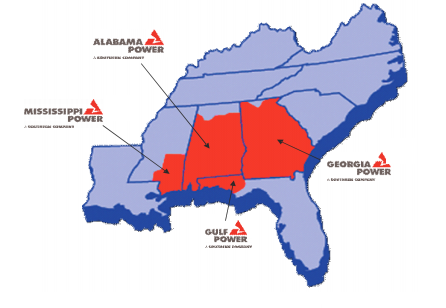
One of the potential customers Clean Line has been courting (or attempting to strong-arm, depending on your perspective) is Georgia Power (GP). Now, for a little bit of clarity and perspective, GP is a subsidiary of Southern Company, and here is their service territory:


According to Wikipedia:
Georgia Power is an electric utility headquartered in Atlanta, Georgia, United States. It was established as the Georgia Railway and Power Company and began operations in 1902 running streetcars in Atlanta as a successor to the Atlanta Consolidated Street Railway Company.
Georgia Power is the largest of the four electric utilities that are owned and operated by Southern Company. Georgia Power is an investor-owned, tax-paying public utility that serves more than 2.25 million customers in all but four of Georgia's 159 counties. It employs approximately 9,000 workers throughout the state.
The Georgia Power Building, its primary corporate office building, is located at 241 Ralph McGill Boulevard in downtown Atlanta.
Unlike Clean Line, they're a serious utility, much like Entergy within the state of Arkansas. They're also leading the way in the southeast for emissions reductions, apparently now without Clean Line. Why do I say this? Let me explain:

Back in January, Georgia Power released their latest proposed Integrated Resource Plan (IRP), in which they lay out their generation requirements for the next twenty years. Here's the full docket. Where Clean Line enters this IRP mix is directly tied to their "REDI" program which is nested within their broader IRP on page 10-106:
As part of its continued effort to responsibly grow the renewable generation market in Georgia and provide energy benefits to all customers, the Company is proposing the procurement of an additional 525 MW of renewable capacity through 2019 if such procurement can be obtained below the Company’s projected avoided costs. In order to provide the maximum amount of benefit to customers, the Company is proposing to procure this energy through three distinct programs: (1) RFPs from renewable developers with utility scale projects to fulfill an annual portfolio capacity target; (2) RFPs from developers with smaller, distributed scale projects to fulfill an annual portfolio capacity; and, (3) smaller, distributed scale solar purchase offerings from Georgia Power customer-sited projects.
Where Clean Line's part would come in:
Under the utility scale portion of the REDI RFPs, Georgia Power proposes to purchase energy from up to 425 MW of renewable generation scheduled to achieve commercial operation no later than December 31, 2019. The Company will file a detailed RFP schedule in September 2016 that will outline the timeline for the 425 MW RFP. The Company will accept proposals for solar, wind, and biomass projects with 2018 or 2019 commercial operation dates (“COD”) based on transmission impacts and overall value. The Company will take ownership of all Renewable Energy Credits (“RECs”) produced by these facilities. Third-party proposals that allow for Georgia Power ownership will be considered.

For utility scale resource bids, the Company will accept proposals for projects that are greater than 3 MW in size, but no larger than 210 MW in size that can attain commercial operation in 2018. The Company will also accept proposals for projects greater than 3 MW in size but no larger than 215 MW in size that can attain commercial operation in 2019. Consistent with the ASI-Prime utility scale RFP, the PPAs will be for a term of up to 30 years. 
For all renewable resources bids, the Company will accept both “as delivered” proposals and “firm block” proposals. The cost of upgrades on Southern Company’s electric system to deliver to Southern Balancing Authority Area load, if required, will be imputed into the total bid costs.

However, for renewable resources located outside of the Southern Balancing Authority Area, proposals must bear all transmission delivery cost and risk to the point of delivery at the Southern Balancing Authority Area interface. The Company will accept proposals for delivery to the Southern Balancing Authority Area interface across high voltage direct current (“HVDC”) lines.
That sounds good for Clean Line, right? Georgia Power accepting proposals from HVDC would be a great thing for them. There's only one problem with it: Those pesky in-service dates. See, Clean Line is pushing the idea that their transmission line will be energized by 2020. My opinion is, even if everything goes exactly as planned for them, there's less than a snowball's chance of that, but that's another post entirely (I think GP knows that, too). The problem with GP's IRP for Clean Line revolves around their proposed "Request for Proposals" (RFP). In the original IRP, the RFP is laid out to be executed as follows:
For utility scale resource bids, the Company will accept proposals for projects that are greater than 3 MW in size, but no larger than 210 MW in size that can attain commercial operation in 2018. The Company will also accept proposals for projects greater than 3 MW in size but no larger than 215 MW in size that can attain commercial operation in 2019. Consistent with the ASI-Prime utility scale RFP, the PPAs will be for a term of up to 30 years. 

Clean Line really wants Georgia Power as a transmission customer. REALLY wants them. Where the "Clean Line whine" enters the picture is with their own David Berry's intervention into the docket to approve Georgia Power's 2016 IRP. See, Clean Line wants everyone in the southeast to have renewable energy as quickly as possible, unless it's not Clean Line's renewable energy. When it turns out that it might not be Clean Line's renewable energy that will enter Georgia Power's mix via their REDI program, they send one of their top guys to try to get the Georgia PSC to maybe persuade GP to change their IRP a little bit to help them out:
  1. Authorize and direct the procurement of additional renewables beyond the 525 MW currently identified in the IRP so long as the resources are below Georgia Power’s avoided cost. Georgia Power currently proposes initiating a Renewable Energy Development Initiative (“REDI”), which includes plans to procure an additional 525 MW of renewable capacity through a REDI Request for Proposal (“RFP”). As identified in the IRP on page 10-104, Table 2: Components by Resource Type- Wind & Biomass, integrating wind resources results in significant benefits due to avoided fuel and purchased power costs, avoided operations and maintenance costs, avoided environmental compliance costs, and avoided capacity costs. The Commission should authorize and direct Georgia Power to procure more than 525 MW of renewables if additional proposals are received that have a higher benefit to Georgia Power ratepayers than cost, which will result in downward pressure in rates.
  2. Maintain the RFP’s flexibility across technologies. Renewable energy technologies, particularly wind and solar, are complementary resources. Wind energy is typically the lowest cost resource, produces more energy per megawatt (“MW”) installed, contributes substantially to meeting winter peak demand and provides for economic development opportunities in the supply chain. Solar energy contributes substantially to meeting summer peak demand and provides for local construction job opportunities. The two resources also complement one another on a time of day basis, and a portfolio of both wind and solar produces less system variability. By increasing the size of the RFP, there will be substantial opportunities to include both cost-effective wind and solar generation into Georgia Power’s supply portfolio.
  3. Accelerate the timing of the RFP to align with the wind Production Tax Credit phase out, resulting in lower costs of wind generation. The REDI RFP should begin as soon as possible to ensure that the wind proposals received capture the full value of the Production Tax Credit (“PTC”). 2016 will be the last year that new wind project construction will be eligible for the full value of the PTC. Wind generators can preserve this value by incurring 5% of the total cost, or starting construction, of the facility during 2016. However, without firm commercial commitments from Georgia Power, wind generation companies are unlikely to invest the significant capital needed to qualify wind farms for the full PTC value in order to supply the lowest cost wind power. Delaying the start of the RFP until late this year, or until 2017, will result in wind generation proposals that are more expensive due to a lower PTC value. 
  4. Allow proposals commencing operations as late as 2021 if they offer higher net benefits to customers. The current construct of the RFP proposes procuring 210 MW of utility scale renewable projects that can attain commercial operation in 2018 and 215 MW of utility scale renewable projects that can attain commercial operation in 2019. This does not provide sufficient time for wind generators using Plains & Eastern or other new transmission lines to come online. Clean Line believes that the lowest-cost renewable resource available to Georgia Power is Oklahoma Panhandle wind power delivered via Plains & Eastern, which will begin delivering energy to the Southeast in 2020. Closing the RFP to such a resource would likely increase costs for Georgia Power customers.
  5. Encourage Georgia Power to evaluate ownership of wind assets. Finally, the RFP should consider the additional benefits to ratepayers if Georgia Power were to own the wind facilities. Clean Line supports the following statement from pg. 10- 106 of the IRP: “third-party proposals that allow for Georgia Power ownership will be considered.” Investments in wind will likely result in a lower delivered cost of energy than the same resource procured via a power purchase agreement, due to Georgia Power’s low cost of capital and efficient use of tax credits. 
Also:
Q. Please explain how specifying required online dates may limit the responses received in the REDI RFP

A. The current construct of the RFP proposes procuring 210 MW of utility scale renewable projects that can attain commercial operation in 2018 and 215 MW of utility scale renewable projects that can attain commercial operation in 2019. The lowest cost wind resource available to Georgia Power is likely to be Oklahoma Panhandle wind delivered via Plains & Eastern, which will begin delivering energy to the Southeast in 2020. Clean Line plans to allocate a majority of the 4,000 MW of transmission capacity to the Southeast to generator-shippers in 2016 and early 2017. This finite resource will not be available if Georgia Power waits until the next IRP cycle in 2019 to evaluate delivered Plains & Eastern wind, and maintaining a 2018 or 2019 required online date may preclude these resources from competing in the proposed REDI RFP.

It would be incredibly convenient for Clean Line if the Georgia PSC directed Georgia Power to adopt these recommendations, wouldn't it?

So, did Mr. Berry get what he wanted? It doesn't appear like he will. Georgia Power did, in fact, increase the amount of renewable energy they'd procure. It also appears that they added a stipulation that only 300mW of energy procured through REDI could be wind. That doesn't help. Did they bend their RFP dates for the sole benefit of including Clean Line? No. Did they say they would consider projects with an in-service date in 2020-2021 in their 2017 RFP? No. Doesn't do a lot to help them:
3. The Renewable Energy Development Initiative ("REDI") is approved and shall be increased such that it will procure 1,200 MW (150 MW of Distributed Generation ("DG") and 1,050 MW of utility scale resources.) Utility scale procurement shall take place through two separate Requests For Proposals ("RFP"). The first RFP will be issued to the marketplace in 2016 and will seek 525 MW of renewables with in service dates of 2018 and 2019. The second RFP will be issued to the marketplace in 2019 and will seek 525 MW of renewables with in service dates of 2020 and 2021. No more than a total of 300 MW of wind resources shall be procured through REDI...
Conclusion: There's a good chance we can cross out Georgia Power from Clean Line's list of potential customers (at least until 2019). It's good news.

Time Is Our Friend

Mr. Berry outlines perfectly on page 19 the reason their project's success is related directly to the Production Tax Credit (PTC). Any pesky delays from landowners or other entities makes their project increasingly less financially feasible as the clock ticks:
V. The REDI RFP should begin as soon as possible, and should allow proposals for delivery later than 2018. 
Q. How will the timing of the REDI RFP affect the wind prices that are received?  
A. The timing of the RFP will have a large effect on the wind proposals received, as the Production Tax Credit will begin a multi-year phase out in 2017. The Consolidated Appropriations Act of 2015 extended the Section 45 PTC for electricity produced from wind generation retroactively to January 1, 2015, and prospectively through the end of 2019. After 2016, the credit will be reduced by 20% for projects that begin construction in 2017, by 40% for projects that begin construction in 2018, and by 60% for projects that begin in 2019. The wind PTC would expire for projects that begin construction on or after January 1, 2020.
Under guidance previously issued by the IRS interpreting the “beginning of construction” rule for qualified renewable power facilities there are two methods that a taxpayer may use to establish that construction of a qualified facility has begun:
1. A taxpayer may establish the beginning of construction by: (a) starting physical work of a significant nature (Physical Work Test) and (b) thereafter maintaining a continuous program of construction. 
2. Under the second method, a taxpayer may establish the beginning of construction by meeting the so-called “5% safe harbor,” which provides that construction of a facility will be considered as having begun if (1) a taxpayer pays or incurs five percent or more of the total cost of the facility before the applicable expiration date, and (2) thereafter, the taxpayer makes continuous efforts to advance towards completion of the facility. 
Wind generators need certainty of offtake arrangements prior to incurring five percent of the total cost of the facility or commencing construction. Georgia Power currently plans to file a detailed RFP schedule with the Commission in September 2016, which would lead to the issuance of the RFP likely in early 2017. This timing would eliminate the potential for wind proposals that include the full value of the PTC. Georgia Power should release the RFP as soon as possible.
This declining PTC value means that the lowest cost wind will be procured in 2016, and the cost of wind energy will rise between 2016 and 2020 as the tax credit is phased out. Improvements in wind turbine technology have significantly increased the capacity factor of wind, thereby lowering the delivered cost of energy, but near-term improvements in turbine technology will not be sufficient to compensate for this lost PTC value. 

Thanks for that description, Mr. Berry. I haven't been able to find a better one anywhere else.

Plains and Eastern is Not "Clean" Anymore

Not only that, but David Berry also admits something that we've known all along, but Clean Line says nothing about: Clean Line is no longer a "clean" line anymore, either. This is found on page 13 of the testimony linked at the top of this section:
Q: Are there any additional value components associated with transmission service across Plains & Eastern that should be evaluated during the renewable RFP process?

A. Yes. In addition to transferring low cost wind, transmission capacity on Plains & Eastern can be used to deliver bulk power from the SPP system during the hours when wind generation is not using the entire capacity of Plains & Eastern. Clean Line has estimated that the ability to deliver SPP market power could save Georgia ratepayers approximately $9 million dollars a year. This calculation assumes that Georgia Power or a wind generator has obtained enough transmission service across Plains & Eastern to deliver 1000 MW to the Southern system.
So, translation: As we all know, the wind doesn't blow all the time. What Mr. Berry is saying here is that, when wind generation isn't supplying full capacity on the line, that extra available capacity could very well be filled with coal-generated power from the bulk SPP system. While Clean Line has been portraying this line as the "green" way to go, it turns out that isn't the whole truth. Who would have thought, right? All of us.
 
What say you Glen Hooks and Bob Allen?

Conclusions
  1. Clean Line needs customers, they seem borderline desperate, and Georgia Power is not likely to be one of those customers anytime soon.
  2. In this case, time is our friend.
  3. The Plains and Eastern "clean line" isn't quite as clean as it has been portrayed. It's turning into a regular old transmission line.

If you made it this far, thanks for reading! :)

Saturday, April 23, 2016

My last blog post… Well, so I hope.


This is my last blog post.


At least it is barring some extreme Clean Line shenanigans. I’ve been meaning to write one for a while now. Ever since the Department of Energy’s Record of Decision/Participation Agreement with Plains & Eastern made it absolutely clear this project would end up in a courtroom instead of ending on Moniz’s desk. I don’t really blame the DOE for that decision… How many federal agencies stand up and say, “No, we really don’t have the power or authority to do XYZ”? It doesn’t happen. And in a way, this is better: Congress proposes, an administration acts, and judges rule. Is a law really a law before it’s been tested by fire? There’s this great line from Robert Graves' I Claudius

"Let all the poisons that lurk in the mud hatch out."

Courtrooms and the discovery process are pretty good places for the hatching out of poisons… And of redacted financial information.

So anyway, what prompted me to finally take up the keyboard for this quasi-final farewell was Clean Line’s self-aggrandizing press release following the defeat of Senator Boozman’s energy bill amendment (thank you, Senator) earlier this week. Don’t worry if you haven’t seen it. It’s not getting much exposure at this point. Maybe it will later. But either way, I promise you... you’ve heard Clean Line say everything in it before. Ad nauseum.

I mean… where to begin? Well, let’s start with the biggest shock. Where is Louis Schmoll? Louis, the landowner from Atkins who gets trotted out and quoted every. single. time Clean Line needs to show how Arkansans support their project. Not enough space to include him and/or Bob AND industry reps perhaps?

Instead, how about we begin with Micheal Skelly’s pleasure at the “bipartisan” nature of the vote? Guess what other big vote was bipartisan? Go on... Guess...

If you were thinking of the 2005 Energy Policy Act, you'd be correct. It passed by an almost 3/4ths majority mix of D&Rs. Compared to that vote, this week’s vote, a.k.a. the “vote to say no” (gag), looks a little weak. And pretty clearly, there are a number of senators ready to tug the reins at the DOE. Is that partisan? Meh, maybe somewhat. But “partisan” isn’t the answer to everything and, if there’s anything we’re learning from this election cycle, it’s that where the politicians are is vastly where the people aren’t.

Now, if you had actually read Clean Line's press release, depending on your point of view, you could have interpreted just a whiff of desperation. A kind of… “Look at us! We won! Pleeeeeeease look at us!” sorta thing. But what exactly did Clean Line “win”? Not much. Legally, this changes nothing. Not the vagueness or contradictions in 1222. Not the attempted application of the law by the DOE. And certainly not the applicability of Plains & Eastern to that law.

They got the adamant support of New Mexico Senator Heinrich (wonder why... WAPA territory, maybe?) and the support of Senators Lankford and Inhofe- yes, he of "snowball on the floor" climate change denying fame- (R-OK) and McCaskill (D-MO). Oh, if only us little people had had an extra $400k to spend in DC last year…  

So, I ask again, what did they win? Besides the chance for the continued confidentiality of certain financials? Well, they won the opportunity to have a senator get up and argue, on the record no less, that Boozman’s amendment… this little report to ensure transparency and fiscal responsibility… is a "job killing amendment". (@3:15:00) Really? Because Plains & Eastern is so vulnerable a report could kill it?

0.o

Yikes. With friends like that, who needs enemies?


Arrivederci


P.S. Omg- I didn't expect to be back so soon. I wrote this on Friday morning. It's now Saturday and all I can say is... clearly, nothing quite has the power to draw the poison out like another proposed amendment. This one, announced by Senator Cotton yesterday afternoon, blocks funding for 1222 projects (thank you, Senator). The response from "Clean Line" was truly breathtaking. Take a look at the sky above you, folks, because if this amendment passes, that sucker is coming down! D.O.W.N! Down! I think they covered just about every threat in the capitalist handbook: Hostile business environment? Check! Harder to build infrastructure? Check! Job KILLER? Check! Higher energy bills? Check! 

Except that... Well, in the interest of time, just read this.  And this. Or, like, open the business section of the Democrat Gazette.

The thing that really grinds my gears, though... The one thing in that statement that doesn't make me snicker into my coffee even a little is the argument that this is going to cause higher energy bills. And to me, it's kind of a perfect example of what I don't like about Clean Line. It assumes we'll pay a higher rate than what they say they can provide for us and presents that as if it were already a reality. The bottom line is that you can't lose what you don't already have.

Finally, this is it I promise, we have this gem: 
The company said the amendment is “a clear example of political meddling targeted at one company and changes the rules in the middle of the game, after tens of millions of private dollars have been invested. The Cotton amendment hurts American consumers and business by undermining the law that was passed under a Republican administration with bipartisan support. 
I have been very careful never to curse on this blog, but oh, how I want to... Instead I'm going to put on my cleanest Battlestar Galactica uniform and say... Frack you, buddy. Frack you.

How about this instead:
Clean Line spending hundreds of thousands of dollars on lobbying efforts in Washington D.C. in direct opposition to the APPROVAL Act is a clear example of big business meddling targeted at a small group of landowners and changes the rules in the middle of the game, after those landowners have spent their lives building sweat and financial equity in their properties, paying their taxes and living like decent human beings. The Cotton amendment is yet another attempt to protect those individuals and their state by bringing attention to a vague and contradictory section of a law that was passed in the era of Cheney's Energy Task Force with a glut of lobbying dollars spent on behalf of industry to provide them with a "piƱata of perks".
Meddling.  Phooey.